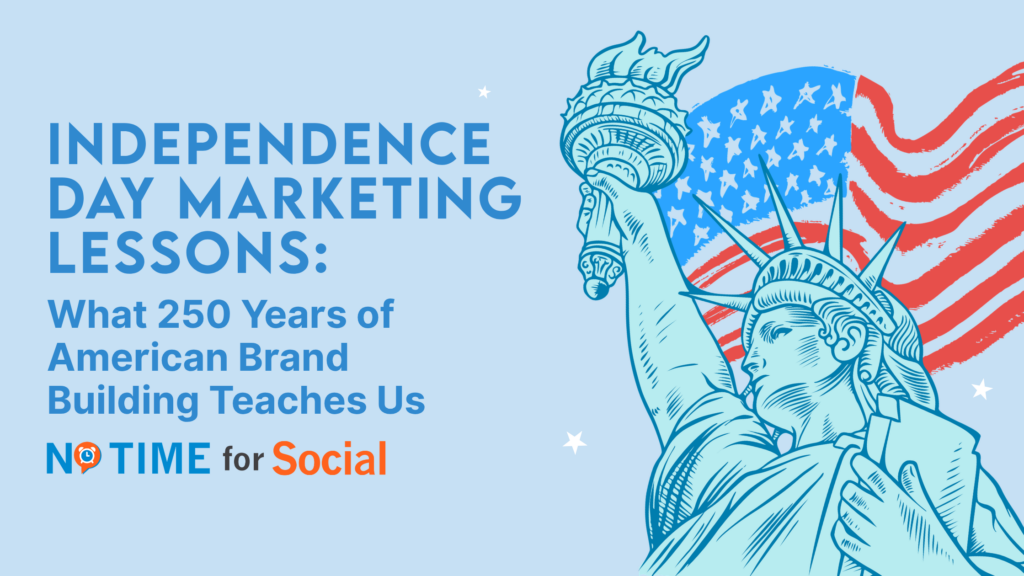
Every July, marketers dust off the same playbook: red, white, and blue graphics, a flag emoji, maybe a sale called “Freedom Fest.” It works fine. It’s also forgettable.
This year is different. 2026 marks 250 years since the Declaration of Independence: the semiquincentennial, if you want the official term, though nobody’s going to put that on a banner. It’s the kind of milestone that only comes around once, and it’s a chance to make a campaign that actually means something rather than just matching the holiday’s color scheme.
But there’s a deeper opportunity here, too. America’s 250-year story isn’t just a backdrop for a sale. It’s arguably the longest-running case study in brand building we have. Here’s what it teaches us.
1. The Best Brands Start With a Clear, Singular Message
The Declaration of Independence is, structurally, one of the most effective pieces of persuasive writing in history. It doesn’t bury the point. It opens with the thesis, builds the case methodically, and closes with a call to action.
Most marketing copy does the opposite: it hedges, qualifies, and buries the offer in paragraph four. The lesson isn’t “write like Jefferson.” It’s: know your one sentence. If you can’t state your brand’s core value proposition as cleanly as “we hold these truths to be self-evident,” you’re not ready to write the ad yet.
2. Founding Myths Are Brand Stories, And They Get Refined Over Time
The story most people know about July 4th —the signing, the bell, the unity—is a simplified, emotionally resonant version of a much messier, multi-year process. That’s not a knock on history; it’s how all enduring narratives work. Brand stories get sanded down over time into something more mythic and more memorable, not less true, but more usable.
If your company’s origin story is an accurate-but-boring paragraph about a founder’s LinkedIn background, you’re missing the lesson. Every legacy brand has a version of its story it tells the public, and it’s never the unabridged one. Figure out your three-sentence myth.
3. Longevity Comes From Reinvention, Not Repetition
A 250-year-old institution doesn’t survive by doing the same thing for 250 years: it survives by reinterpreting its core values for each generation. The meaning of “liberty” in 1776 and what it represents in marketing and culture today are not the same conversation, even if the word hasn’t changed.
This is the difference between brands that feel dated and brands that feel timeless. Coca-Cola’s “Open Happiness” isn’t the same campaign as its 1971 “Hilltop” ad, but it’s recognizably the same brand promise, restated for a new moment. If your brand guidelines haven’t evolved in five years, you’re not being consistent; you’re being static.
4. Symbols Outperform Sentences
Nobody needs the Declaration’s full text to feel patriotic in July. A flag, a firework, a specific shade of blue does the emotional work instantly. Strong brands compress meaning into symbols, a swoosh, a golden arch, a sonic logo, so the audience doesn’t have to read anything to feel something.
If your brand’s entire identity lives in a tagline and nowhere else, you don’t have a symbol yet. You have a sentence. Sentences are forgettable. Symbols are not.
5. The Most Resilient Brands Leave Room for Reinterpretation
Part of why “the American Dream” has stayed culturally potent for two and a half centuries is that it was never tightly defined. It’s vague enough that wildly different people can pour their own meaning into it and feel like it’s speaking to them directly.
This runs counter to much modern brand strategy advice, which pushes for hyper-specific positioning. There’s a real tension here worth sitting with: specificity wins short-term clarity and conversion; openness wins long-term cultural relevance. The biggest legacy brands manage both — a specific product promise wrapped in a more open, aspirational identity.
What This Means for Your July Campaign
You don’t need to compare your SaaS product to the Founding Fathers (please don’t). But the semiquincentennial is a legitimate hook for content this year, and it’s a good prompt for a broader audit:
- Can you state your core promise in one clear sentence, with no hedging?
- What’s the three-sentence version of your origin story, the one people will actually repeat?
- Do you have a visual or sonic symbol that works without any text attached?
- Has your brand’s expression evolved in the last few years, or are you running the 2021 playbook with a new coat of paint?
The brands that get remembered aren’t the ones with the loudest July 4th sale. They’re the ones whose core message could survive 250 years of cultural change without losing what made it resonate in the first place. That’s a high bar. It’s also the only one worth aiming for.
This Independence Day, take a closer look at your brand. Are you building something memorable, recognizable, and trusted over time? At No Time for Social, we help businesses throughout Round Rock and Central Texas develop marketing strategies that strengthen brand awareness, connect with customers, and drive long-term growth. Visit notimeforsocial.com/contact or call/text 512-721-0333 to start building a brand that stands the test of time.